
by Debbie Lefebre
“Baby Season” is a hectic time in a wildlife rehabilitation centre, especially for those of us who care for orphaned songbirds. Their care is delicate and time-consuming. Hatchlings must be fed every 10 to 15 minutes from dawn to dusk. Nestlings and young fledglings are fed every half hour. In the wild, most young are fed an insect-based diet by the parent birds (Mourning Doves and American Goldfinches are notable exceptions), so we try to replicate as closely as possible their natural diet. Very young birds are syringe-fed a formula specially developed for insectivores and gradually transition to a combination of formula and prepared insects such as mealworms and crickets.
As they grow to fledgling stage, we wean them off formula and begin to offer a more species-specific diet. A sparrow or finch, for example, will get more seeds and fewer insects. An American Robin will get an earthworm and some chopped fruit for dessert. At this stage, the aim is to get the youngsters to feed themselves the food we make available in their indoor enclosures.
To prepare for release, fledglings are moved outdoors to a flight pen. This gives them the opportunity to develop their flight skills. In this crucial period of “wilding up”, contact with humans is drastically reduced. In addition to the foods they were fed while still housed indoors, the fledglings receive many natural plant and insect foods to encourage them to learn to forage and recognize food sources that are not dependent on human intervention. One of our best resources for diet information is the Cornell Ornithology website (allaboutbirds.org) which has detailed information about the insects and native plants that each species of songbird uses for food and, in many cases, nesting materials.
Songbirds, both the species that migrate to Canada to breed and the year-round residents, developed the ability to forage for foods ideally suited to their dietary needs over centuries, relying on the insects and plants that were here before Europeans arrived. Humans have had an impact on these diets, sometimes advantageous, sometimes negative. High-quality bird seed, suet blocks and peanuts, for example, make feeding so much easier for neighbourhood birds, particularly those that overwinter. However, the natural landscapes that once covered North America have given way to industrial, commercial and residential development resulting in a significant decrease of many songbirds’ traditional foods (nuts, berries and seeds).
Cedar waxwing eating serviceberry.
Leaving native plants with seed heads intact through the winter may look untidy but can be a boon for birds in snowy months. Unfortunately, society’s desire for “polite” plantings (often non-native) and swaths of manicured lawns create limited feeding opportunities for birds. To some of my neighbours in urban London, Ontario, my garden is singularly “impolite” with its milkweeds (Asclepias spp.), Joe Pye weeds (Eupatorium spp.), goldenrods (Solidago spp.) and others – all clearly regarded as weeds. Many birds, bees and butterflies, on the other hand, see my yard as the best restaurant in town. In deference to my neighbours’ sensibilities, I grow pokeweed (Phytolaca americana) and wild grapes (Vitis spp.) in a secluded part of my backyard since both tend to be rather zealous, unkempt plants. As a result, my neighbours miss seeing Cedar Waxwings, American Robins, Red-bellied Woodpeckers, American Cardinals and Evening Grosbeaks happily dining on these fruits. These birds are just some of over 30 species that eat from the native plant smorgasbord that I offer. Note that most parts of the pokeweed are toxic to livestock and humans so children should be warned against picking the richly coloured berries but many migratory birds use the fruits to fuel up at the end of summer.
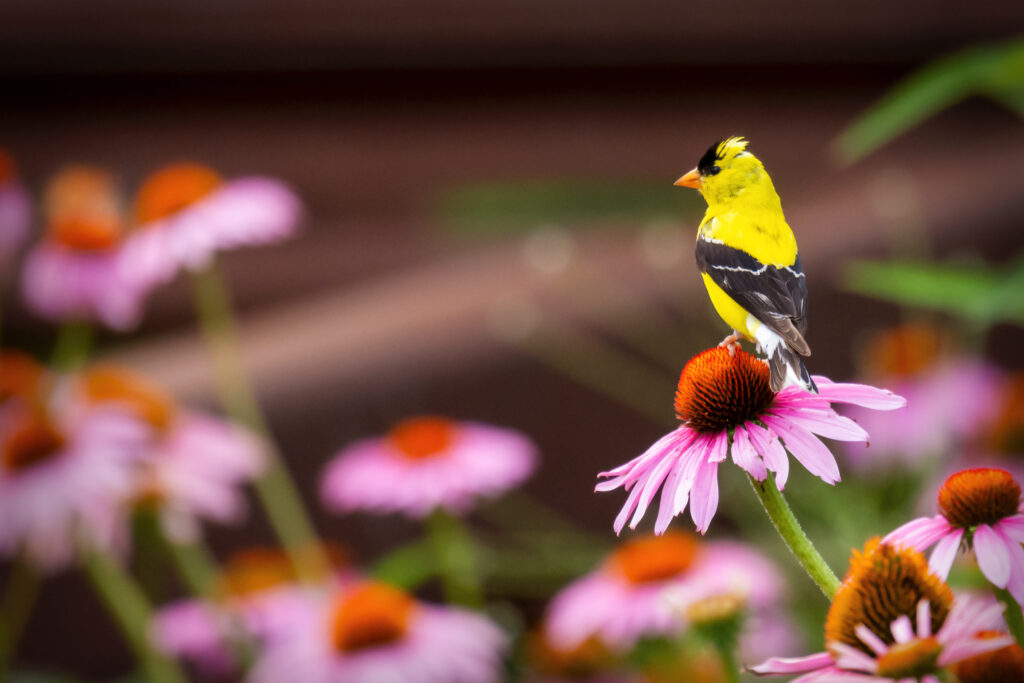
American Goldfinches are late season breeders that rely heavily on the seed head stage of native plants. Thistles (Cirsium spp.) are a favourite food source as are goldenrods and asters (Symphyotrichum spp.). While the goldfinches will feed on a variety of plants, I have found evening primrose (Oenothera biennis) to be a veritable magnet for them. The plants are tall, appealing beacons of bright yellow blooms which open at dusk. After the flowers fade and the seed pods form, it is a common sight in my front garden to see what looks like a resurgence of blooms but is actually a flock of goldfinches. The cheerful birds are clinging to evening primrose’s tall spikes as they pick open the pods to get at the tiny seeds.
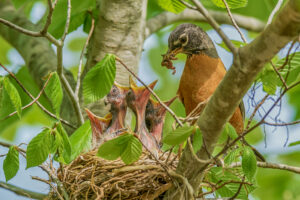
My rehab partner Carolyn and I have become expert scavengers as we look for appropriate forage material for the pre-release birds. We know where to find crabapples (Malus spp.), mountain ashes (Sorbus spp.), staghorn sumacs (Rhus typhina), viburnums (Viburnum spp.), alders (Alnus spp.), mulberries (Morus spp.), serviceberries (Amelanchier spp.), cedars (Thuja spp.) and Virginia creepers (Parthenocissus quinquefolia), among others. We raid our own gardens for forage and Carolyn’s rural neighbours graciously allow us access to their trees, shrubs and vines.
One of the most positive developments in the past few years has been the growing recognition of native plants. The rise in popularity of purple coneflowers (Echinacea spp.), a big favourite with American Goldfinches and Red and House Finches, seemed to open the door for other wild plants to gain respectability. Even the once despised common milkweed (Asclepias syriaca) has been delisted as a noxious weed [RCN: in Canada – it has never been listed as such in NC, USA]! This change of viewpoint is leading to a replenishment of natural food sources for many species of wildlife, particularly the songbirds that bring so much delight and interest to our gardens.
Releasing our “babies” is a stressful time for us. Like anxious parents, we send them out into the wild hoping that our weeks of care and training will have prepared them adequately to make a good living in the world. Often, birds released in my garden or at Carolyn’s rural property will return the next season. This past summer, a robin hand reared by Carolyn in 2013 not only returned but decided to raise young in a nest right near her front door. We are grateful that more and more gardeners are forsaking the formal, stylized, often sterile garden plan to provide a welcome pantry for our beloved Birds.
Debbie Lefebre and Carolyn Denstedt operate Swift Care Ontario, a wildlife rehabilitation centre in southwestern Ontario specializing in species at risk, notably Chimney Swifts, Bank Swallows, Barn Swallows, Eastern Whip-poor-wills and Common Nighthawks. Swift Care Ontario is Nature London’s 2014 Conservation Award Winner.
Originally published in The Blazing Star, the North American Native Plant Society quarterly, nanps.org. Reprinted with permission.
Thank you to the late Debbie Lefebre and the North American Native Plant Society – RCN