
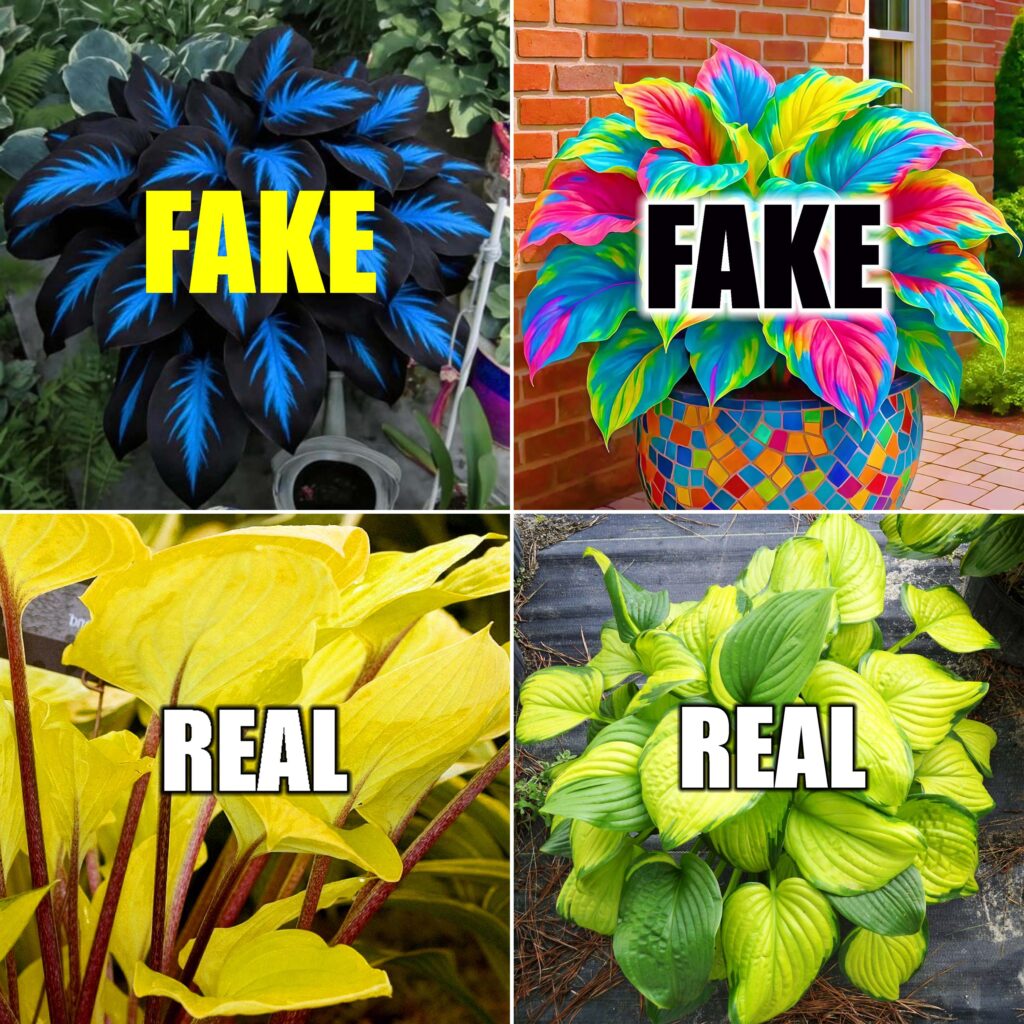
Clockwise, from upper left: Real picture with fake/altered Hosta, AI with fake picture and plant, Real picture and real Hosta ‘Stained Glass‘, Real picture and real Hosta ‘Fire Island’.
It’s 2026 and sadly fake plants are all over the internet. This is not a new issue, but thanks to AI, the pictures are getting more and more convincing. Places like Amazon and Etsy are notorious for selling “seeds” of dayglo plants that do not reflect reality.
If plant breeders ever figure out how to grow neon purple and pink Hostas, or glow in the dark roses, the horticultural industry would go nuts! You would find them on shelves at premium prices, winning awards, they would be patented, they would be featured in botanical gardens!
If you’re finding plants in crazy, unbelievable colors for extraordinarily low prices – proceed very carefully.
Other red flags include:
- No scientific or Latin name for the plant anywhere in the listing.
- Pictures that don’t make botanical sense, such as a cactus with leaves.
- Little to no care information on how to take care of a supposedly incredibly rare plant.
- Seeds for plants not normally sold as seeds (such as Hostas).
- No street address for the business.
- Free or very low (and also fast) shipping promised. Real, super rare plants are not actually going to ship worldwide in 2 days.
- Fake reviews with only a few words and generic names.
Roses and orchids are also notorious plants for this, as those with white blooms can be given colorful dyes in their water which can temporarily turn their flowers unusual colors. These aren’t so much fake plants but wildly misleading, which has broken the heart of many gardeners.
In the end, some victims of these plant and seed scammers don’t get anything for their money. Others may receive actual weeds, or very basic versions of the plant. Many times the seller has mysteriously disappeared by the time the gardener realizes what has happened, and no refunds are available.
We encourage all of our customers to shop with reputable companies like ourselves, and to do their research first. Obviously the best way to avoid these scams is to shop with us and other local companies where you can see the plants yourself! But for those who prefer online shopping, be mindful, and research the plants you’re interested in first. Some of our favorite places for trusted, reliable plant information, including cultivars, are the North Carolina Extension Gardener Plant Toolbox and the Missouri Botanical Garden Plant Finder.
There are also national groups for plant professionals and serious plant enthusiasts, for example, the American Hosta Society keeps track of registered Hosta cultivars. Roses also have some excellent resources, such as the American Rose Society and HelpMeFind. The internet is full of fantastic plant information, if you dig into the quality resources out there.